Yoga: Science of the Absolute: A Commentary on the Yoga Sutras of Patanjali by unknow
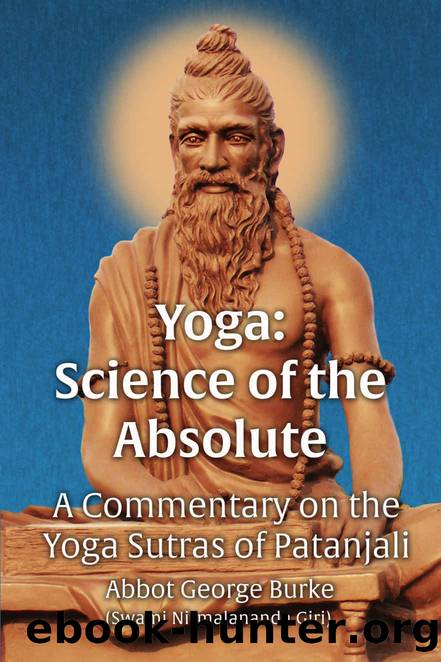
Author:unknow
Language: eng
Format: epub
Tags: Enlightenment, Hinduism, India, Indian Philosophy, karma, Mantras, Meditation, meditation method, meditation methods, meditation techniques, mindfulness, patanjali, Personal Growth, Philosophy, raja yoga, Religion, scripture, Self Help, Spirituality, Yoga, yoga meditation, yoga method, ashtanga yoga, yoga sutras
Publisher: Light of the Spirit Press
Published: 2019-02-18T18:30:00+00:00
Kaivalya Pada:
Yoga Sutras Book IV
This is a very interesting yet somewhat puzzling section of the Yoga Sutras because it covers a variety of subjects seemingly at random, though more than one sutra may be devoted to a single subject. However it may be, here it is.
1. The Siddhis are the result of birth, drugs, mantras, austerities or samadhi.
Patanjali listed various siddhis in the Sadhana Pada: Book II. He also outlined which of the yamas or niyamas would lead to those siddhis. We can question as to whether he is harking back to them or is giving us a blanket exposition relating to any other psychic powers that may arise in the sadhaka. I personally think the latter is correct and will approach it from that viewpoint. There are five possible sources or producers of the siddhis.
Birth [janma]. This means that siddhis can be carried over from previous births in which they were developed, that they are a part of the person’s samskaras.
Drugs [aushadhi]. At the time of Patanjali allopathic drugs and the various concoctions current today were not known. “Aushadhi” means herb-based. It is well known that certain herbs or plants can produce psychic abilities that usually disappear as the effect of the drug wears off, though there can remain a kind of heightened sensitivity or mental distortion that is at best borderline pathological.
Patanjali is not advocating the use of herbs or plants to develop siddhis. Rather, he is informing us that siddhis are not always signposts of psychic development or spiritual evolution, but merely the result of having ingested certain herbs or plants. Some unfortunate individuals are permanently damaged physically or psychically by these plants and consider themselves enlightened or possessing some exalted status. This, too, is pathological. No real yogi countenances the use of such substances.
Mantra. It is well known in India that certain mantras can bestow powers on those who attain what is known as “mantra siddhi.” There are even certain places in India where a person can attain mantra siddhi more rapidly than in an ordinary location.
For decades, a man simply called Poison King cured people of snakebite. The government of India had arranged that to send a telegram to him to report someone needing neutralization of poison, including cobra venom, a person need only use the address “Poison King.” The telegram would be rushed to him. He always carried a towel slung over one shoulder, and when he got a telegram he would tear a narrow strip off the towel while reciting a mantra. Instantly the person would be free of the effects of the poison.
I met a man who had the same siddhi. Through mantra he had actually brought back to life a man declared dead by a hospital in New Delhi. Being “scientific” the hospital refused to acknowledge the fact and cancel the death certificate. So the man remained legally dead for the rest of his life!
I have known of people who cured illness through mantra and also were able to know what was going on at a distance and to know the future through mantra.
Download
This site does not store any files on its server. We only index and link to content provided by other sites. Please contact the content providers to delete copyright contents if any and email us, we'll remove relevant links or contents immediately.
Personalized inhaled bacteriophage therapy for treatment of multidrug-resistant Pseudomonas aeruginosa in cystic fibrosis by unknow(176860)
CONSORT 2025 statement: updated guideline for reporting randomized trials by unknow(85314)
Critical evaluation of the ProfiLER-02 study design and outcomes by Vivek Subbiah & Razelle Kurzrock(84940)
Cardiac gene therapy makes a comeback by Oliver J. Müller & Susanne Hille & Anca Kliesow Remes(84702)
Whisky: Malt Whiskies of Scotland (Collins Little Books) by dominic roskrow(74441)
Unveiling the design rules for tunable emission in graphene quantum dots: A high-throughput TDDFT and machine learning perspective by Şener Özönder & Mustafa Coşkun Özdemir & Caner Ünlü(50894)
A yeast-based oral therapeutic delivers immune checkpoint inhibitors to reduce intestinal tumor burden by unknow(40264)
Covalent hitchhikers guide proteins to the nucleus by Alexander F. Russell & Madeline F. Currie & Champak Chatterjee(40216)
Meet the Authors: Christopher R. Mansfield and Emily R. Derbyshire by Christopher R. Mansfield & Emily R. Derbyshire(40096)
Alkaline-earth metals promote propane dehydrogenation with carbon dioxide through geometric effects: Altering the reaction pathway by unknow(32734)
Induced iron vacancies boosting FeOOH loaded on sustainable Fenton-like collagen fiber membrane for efficient removal of emerging contaminants by unknow(32509)
Efficient electric-field-assisted photochemical conversion of methane to n-propanol exclusively over penetrated TiO2Ti hollow fibers by Guanghui Feng(32454)
Bi2SiO5 nanosheets as piezo-photocatalyst for efficient degradation of 2,4-Dichlorophenol by Hangyu Shi & Yifu Li & Lishan Zhang & Guoguan Liu & Qian Zhang & Xuan Ru & Shan Zhong(32389)
A novel NDIPTA organic heterojunction photocatalyst with built-in electric field for efficient hydrogen production by Jiahui Yang & Baojun Ma & Yongfa Zhu(32362)
Enhanced conversion of methane to liquid-phase oxygenates via hollow ferrite nanotube@horseradish peroxidase based photoenzymatic catalysis by Jun Duan & Shiying Fan & Xinyong Li & Shaomin Liu(32333)
Ordered macroporous superstructure of defective carbon adorned with tiny cobalt sulfide for selective electrocatalytic hydrogenation of cinnamaldehyde by Xiao-Shi Yuan & Sheng-Hua Zhou & San-Mei Wang & Wenbo Wei & Xiaofang Li & Xin-Tao Wu & Qi-Long Zhu(32259)
What's Done in Darkness by Kayla Perrin(27150)
Topological analysis of non-conjugated ethylene oxide cored dendrimers decorated with tetraphenylethylene: Insights from degree-based descriptors using the polynomial approach by A Theertha Nair & D Antony Xavier & Annmaria Baby & S Akhila(26528)
Investigation of mechanical and self-healing properties of hydroxyl-terminated polybutadiene functionalized with 2-ureido-4-pyrimidinone by Mohsen Kazazi & Mehran Hayaty & Ali Mousaviazar(26460)
